Preprint · 2026
Multi-Agent & Game-Theoretic PlanningEfficiently Solving Mixed-Hierarchy Games with Quasi-Policy Approximations
Hamzah Khan, Dong Ho Lee, Jingqi Li, Tianyu Qiu, Christian Ellis, Jesse Milzman, Wesley Suttle, David Fridovich-Keil
arXiv preprint arXiv:2602.01568, 2026
Abstract
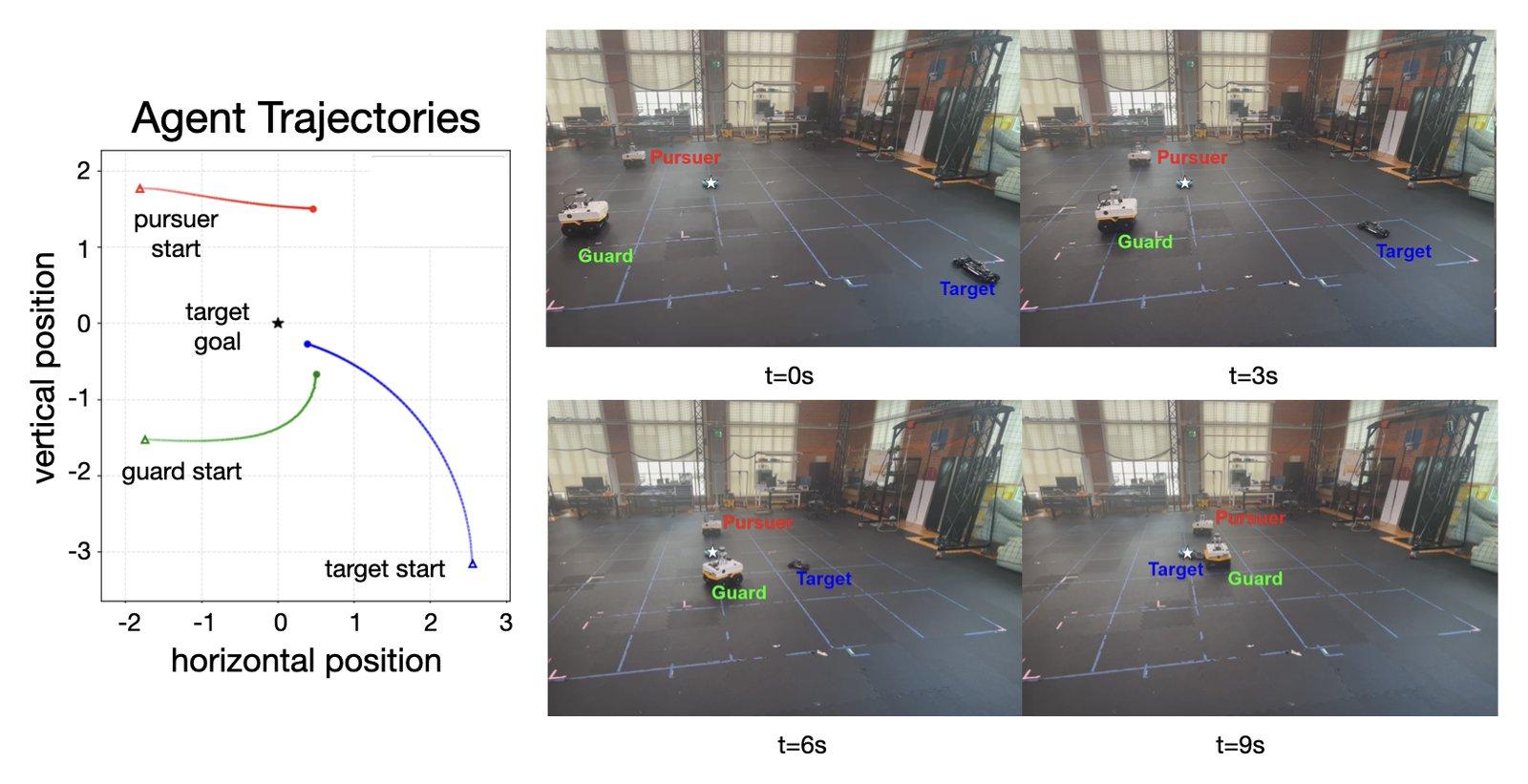
Multi-robot coordination often exhibits hierarchical structure, with some robots' decisions depending on the planned behaviors of others. While game theory provides a principled framework for such interactions, existing solvers struggle to handle mixed information structures that combine simultaneous (Nash) and hierarchical (Stackelberg) decision-making. We study N-robot forest-structured mixed-hierarchy games, in which each robot acts as a Stackelberg leader over its subtree while robots in different branches interact via Nash equilibria. We derive the Karush-Kuhn-Tucker (KKT) first-order optimality conditions for this class of games and show that they involve increasingly high-order derivatives of robots' best-response policies as the hierarchy depth grows, rendering a direct solution intractable. To overcome this challenge, we introduce a quasi-policy approximation that removes higher-order policy derivatives and develop an inexact Newton method for efficiently solving the resulting approximated KKT systems. We prove local exponential convergence of the proposed algorithm for games with non-quadratic objectives and nonlinear constraints. The approach is implemented in a highly optimized Julia library (MixedHierarchyGames.jl) and evaluated in hardware and simulated multi-agent experiments, demonstrating real-time convergence for complex mixed-hierarchy information structures.
Cite
@misc{khan2026efficiently,
  title = {{Efficiently Solving Mixed-Hierarchy Games with Quasi-Policy Approximations}},
  author = {Hamzah Khan and Dong Ho Lee and Jingqi Li and Tianyu Qiu and Christian Ellis and Jesse Milzman and Wesley Suttle and David Fridovich-Keil},
  year = {2026},
  eprint = {2602.01568},
  archivePrefix = {arXiv}
}