Journal article · 2026
Multi-Agent & Game-Theoretic PlanningLinear-Quadratic Gaussian Games with Distributed Sparse Estimation
Tianyu Qiu, Filippos Fotiadis, Xinjie Liu, Christian Ellis, Jesse Milzman, Wesley Suttle, Ufuk Topcu, David Fridovich-Keil
IEEE Control Systems Letters, vol. 10, pp. 1237-1242, 2026
Abstract
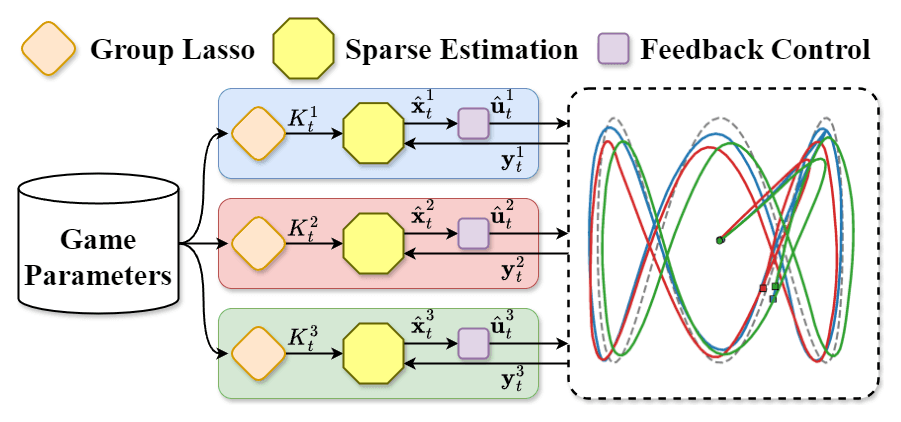
Linear-quadratic Gaussian games provide a framework for modeling strategic interactions in multi-agent systems, where agents must estimate system states from noisy observations while also making decisions to optimize a quadratic cost. However, these formulations usually require agents to utilize the full set of available observations when forming their state estimates, which can be unrealistic in large-scale or resource-constrained settings. In this paper, we consider linear-quadratic Gaussian games with sparse interagent observations. To enforce sparsity in the estimation stage, we design a distributed estimator that balances estimation effectiveness with interagent measurement sparsity via a group lasso problem, while agents implement feedback Nash strategies based on their state estimates. We provide sufficient conditions under which the sparse estimator is guaranteed to trigger a corrective reset to the optimal estimation gain, ensuring that estimation quality does not degrade beyond a level determined by the regularization parameters. Simulations on a formation game show that the proposed approach yields a significant reduction in communication resources consumed while only minimally affecting the nominal equilibrium trajectories.
Cite
@article{qiu2026linear,
  title = {{Linear-Quadratic Gaussian Games with Distributed Sparse Estimation}},
  author = {Tianyu Qiu and Filippos Fotiadis and Xinjie Liu and Christian Ellis and Jesse Milzman and Wesley Suttle and Ufuk Topcu and David Fridovich-Keil},
  year = {2026},
  journal = {IEEE Control Systems Letters},
  volume = {10},
  pages = {1237--1242},
  doi = {10.1109/lcsys.2026.3703777}
}